
Artificial Intelligence artwork (commonly called AI Art) is, as the name implies, artwork that is generated using Artificial Intelligence algorithms. For example, the below image was generated using the craiyon.com AI art generator with the prompt “a bowl of tomato soup sitting on a countertop”.

It looks rather realistic and appetizing, doesn’t it? The generator even added a garnish and a spoon to the picture, even though I never asked for those. How does an AI know what I’m asking it to create in the first place?
AI art generator algorithms function by learning “a specific aesthetic by analyzing thousands of images”; the algorithm “then tries to generate new images in adherence to the aesthetics it has learned” (Elgammal). So, using the tomato soup image from before, the AI searches through tons of images that are related to tomato soup. Then, after analyzing each of those images, it creates a new picture based on what it saw.
If that seems confusing, think of it this way. Say I ask you to draw a picture of a hippopotamus, and say you’ve never seen- or even heard of- a hippopotamus before. I then show you three pictures of a hippopotamus. Regardless of your artistic skills, you can probably at least make a rough sketch of a hippopotamus. This is basically how AI art generators work. They aren’t perfect, however. Take this below picture of George Washington, first president of the United States of America.
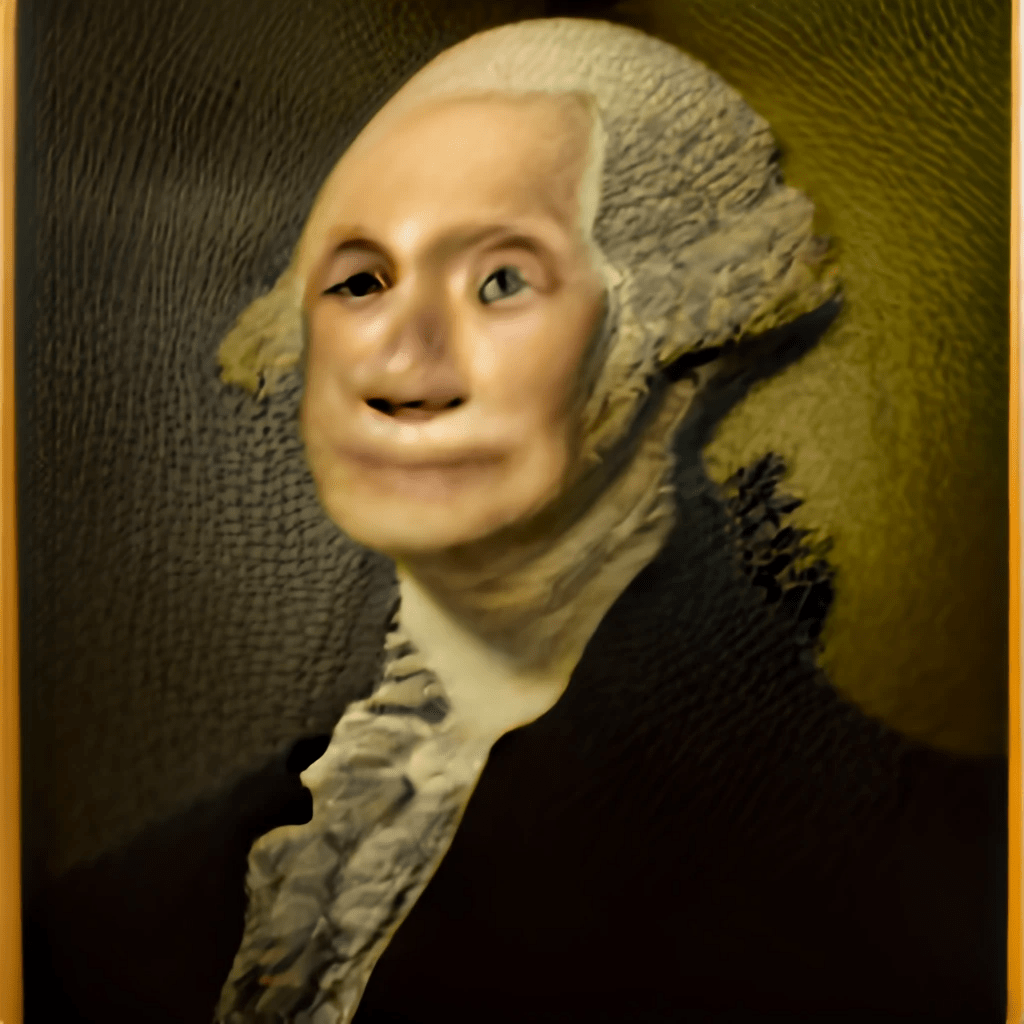
Sure, it looks, in essence, like George Washington, but it clearly has flaws. But this image also highlights one of the biggest concerns with AI art generators. This image of George Washington looks very similar to the image of George Washington that can be found on the George Washington Wikipedia page. Could this be infringing on the rights of artists? Not only that, but it’s been reported that some AI art generators incorporate pieces of images they’ve “observed” in their generations, including possible signatures or replications of signatures (Escalante-De Mattei).
Overall, it is clear that AI art generators still have a lot of improving to do, especially with human portraits (a clever trick to spot AI art is to take a look at the faces and hands, as those are usually deformed). It is also possible that legislation may be passed in terms of whether AI art can be considered true art, parodies of art, or something else entirely. But, for now, it is, in my opinion, a fun tool to play around with.
Resources & Further Reading
Elgammal, Ahmed. “Ai Is Blurring the Definition of Artist | American Scientist.” American Scientist, Sigma Xi, https://www.americanscientist.org/article/ai-is-blurring-the-definition-of-artist.
Escalante-De Mattei, Shanti. “Artists Voice Concerns over the Signatures in Viral LensaAI Portraits.” ARTnews.com, ARTnews.com, 9 Dec. 2022, https://www.artnews.com/art-news/news/signatures-lensa-ai-portraits-1234649633/.

 The H.A.C.K.E.R. Project
Leave a comment