
A new Apple product has reached the market: the Apple Vision Pro. As of “Friday, February 2, [the Apple Vision Pro has been made available] at all U.S. Apple Store locations and the U.S. Apple Store online” (Roy and Schubert). This new piece of Apple technology is Apple’s first major step into the realm of virtual reality (VR) technology software, intending to blend both the entertainment value that other VR technologies bring with the usability and usefulness of a standard desktop computer. Furthermore, the Apple Vision Pro “builds on Apple innovation and experience designing high-performance products like Mac, iPhone, and wearables like Apple Watch, culminating in the most advanced personal electronics device ever” (Roy and Schubert). In addition, this product serves as competition for other similar VR headsets such as Meta’s Quest 3 VR headset, the latest model in the Quest series. The Apple Vision Pro is now “available starting at $3,499 (U.S.) with 256GB of storage”, and the online Apple Store listing for the product can be found here (Roy and Schubert).
What is the Apple Vision Pro?
Apple states that the Vision Pro is a “revolutionary spatial computer that transforms how people work, collaborate, connect, relive memories, and enjoy entertainment” (Roy and Schubert). Physically, however, the Apple Vision Pro is much like a virtual reality headset, as can be seen in the image from Apple’s online store below:
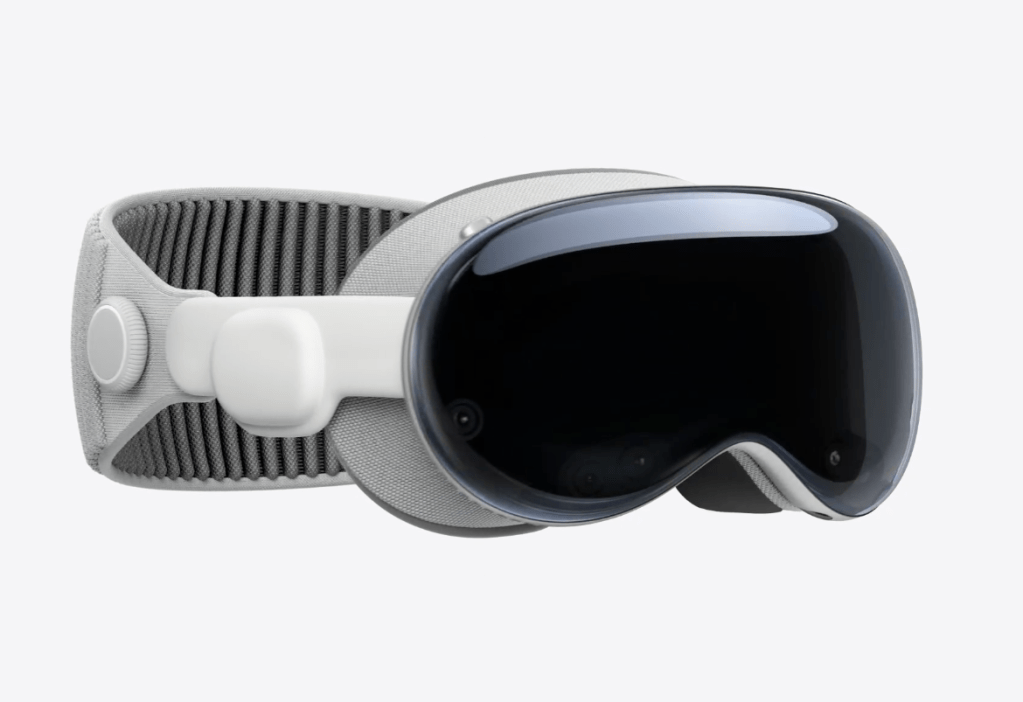
The Apple Vision Pro is composed of “a singular piece of three-dimensionally formed, laminated glass” meant to provide a sleek and stylish appearance, a Light Seal which “is made of a soft textile and comes in a range of shapes and sizes”, which is able to cushion the user’s face and also allows a user to select a size that fits best, as well as two types of straps to keep the Vision Pro securely attached to the user: the Solo Knit Band, which is a singular strap that wraps around the back of the head, and the Dual Loop Band, which includes a strap that goes around the back of the head and a second strap that wraps around the top of the head in order to provide extra support (Roy and Schubert).
The Apple Vision Pro, as mentioned previously, is “designed as a modular system so users can personalize their fit”; users are able to swap out various parts of the Vision Pro, such as the band and Light Seal, in order to make it the most comfortable and usable for them (Roy and Schubert). In addition, users can purchase ZEISS Optical Inserts which “magnetically attach to the Vision Pro”, allowing users who require glasses for reading or as a prescription to fully utilize the headset without needing to wear one’s glasses (Roy and Schubert).
The display screen inside the Apple Vision Pro is “a breakthrough ultra-high-resolution display system built on top of Apple silicon”, and it also employs “micro-OLED technology to pack 23 million pixels into two displays, each the size of a postage stamp, with wide color and high dynamic range” (Roy and Schubert). The Apple Vision Pro utilizes a dual chip system: in addition to the M2 chip that is part of Apple silicon, the Vision Pro also includes the “brand-new R1 chip [that] processes input from 12 cameras, five sensors, and six microphones to ensure that content feels like it is appearing right in front of the user’s eyes” (Roy and Schubert). The onboard operating system of the Vision Pro is visionOS, which enables users to control the headset using their eye movements, hand gestures, and voice commands to “seamlessly blend… digital content with the physical world and unlock… powerful spatial experiences” (Roy and Schubert). Specifically, the Apple Vision Pro incorporates a “high-performance eye tracking system that uses high-speed cameras and a ring of LEDs that project invisible light patterns onto the user’s eyes for responsive, intuitive input” (Roy and Schubert). The Vision Pro then tracks changes in these light patterns in order to determine eye movement. In addition, the Vision Pro includes a “brand-new three-dimensional user interface that creates… an infinite canvas for multitasking and collaborating” (Roy and Schubert).
If you are interested in the manufacturing process of an Apple Vision Pro, Apple released a short YouTube video that shows many of the steps taken in the process of creating the Vision Pro.
Finally, Apple states that the Vision Pro has been
designed with the environment in mind, with 100 percent recycled rare earth elements in all magnets and 100 percent recycled tin soldering and gold plating in multiple printed circuit boards. The frame and battery enclosure contain 100 percent recycled aluminum, and the Light Seal and Solo Knit Band are each made with over 70 percent recycled yarn. Vision Pro meets Apple’s high standards for energy efficiency and is free of mercury, brominated flame retardants, PVC, and beryllium. The packaging is 100 percent fiber-based, bringing Apple closer to its goal of eliminating plastics in all packaging by 2025.
Roy and Schubert
What Can the Apple Vision Pro Do?
With all of the above hardware and software specifications, it is natural to be curious as to what exactly the Apple Vision Pro is capable of. The Vision Pro boasts many features to attract users of all kinds, including and fueled by “an all-new App Store [that] provides users with access to more than 1 million compatible apps” (Roy and Schubert).
In their press release, Apple summarized the capability of the Vision Pro in three bullet points:
Roy and Schubert
- An infinite canvas for productivity:With key productivity and collaboration apps like Fantastical, Freeform, JigSpace, apps from Microsoft 365, and Slack, Apple Vision Pro is an ideal productivity tool for everyday tasks. Apps can appear side by side at any scale for incredible multitasking, and with support for Magic Keyboard and Magic Trackpad, users can create the perfect workspace. With Mac Virtual Display, users can even bring the powerful capabilities of their Mac into Vision Pro, creating an enormous, private, and portable 4K display, ideal for pro workflows.
- The ultimate entertainment experience: Apple Vision Pro features ultra-high-resolution displays that deliver more pixels than a 4K TV for each eye, enabling users to watch movies and TV shows from Apple TV+, Disney+, Max, and other services on a screen that feels 100 feet wide with support for HDR content. Within the Apple TV app, users can access more than 150 3D titles with incredible depth wherever they are. Vision Pro also introduces Apple Immersive Video, a remarkable new entertainment format pioneered by Apple that puts users inside the action with 180-degree, three-dimensional 8K recordings captured with Spatial Audio. Users can also enjoy new interactive experiences like Encounter Dinosaurs.
- New gaming experiences: Players can access games on the App Store, including more than 250 titles on Apple Arcade. Hit games like NBA 2K24 Arcade Edition and Sonic Dream Team can be played on a screen as large as they want with incredible audio and support for popular game controllers. New spatial games, including Game Room, What the Golf?, and Super Fruit Ninja, take advantage of the powerful capabilities of Apple Vision Pro to transform the space around players, offering unique and engaging gameplay experiences.
The Apple Vision Pro is not simply a virtual reality headset meant for gaming; rather, it is meant to be a versatile piece of technology that can be used in a variety of settings, such as in the office, at home, or even on the go. The Vision Pro includes a useful feature called “Environments”, which allows users to “immerse themselves… in dynamic, beautiful landscapes… to help them focus or reduce clutter in busy spaces” (Roy and Schubert). The device does not simply provide features to block out a user’s surroundings, however; it also includes the “EyeSight” feature that allows a user to “stay connected to the people around them” (Roy and Schubert). This feature, essentially, causes the front screen of the device to appear transparent, allowing the user to see outward “while also displaying the user’s eyes” to onlookers (Roy and Schubert).
In addition to capturing eye movements to control the device, the Apple Vision Pro incorporates a new form of authentication for Apple devices: Optic ID. Optic ID “analyzes a user’s iris to unlock Vision Pro, autofill passwords, and complete payments with Apple Pay” (Roy and Schubert). Users are also able to capture spatial photos and videos using their headset, which, in addition with the spatial audio feature, can “transport users to a special moment in time” and view “all their photos and videos at a life-size scale with brilliant color and spectacular detail” (Roy and Schubert).
One of the traditional Apple features, FaceTime, is also built into the Apple Vision Pro. This version of FaceTime “takes advantage of the space around the user so that everyone on a call appears life-size, while Spatial Audio makes it sound like each person’s voice comes from the location of their tile” in an attempt to make the call feel as realistic as possible (Roy and Schubert). Specifically, if “a user is wearing Vision Pro while on FaceTime, they appear as their Persona, while others joining from a Mac, iPad, or iPhone will appear in a tile” (Roy and Schubert). A user’s Persona is, essentially, a 3D model rendering of the user generated by the Vision Pro in order to “others on a [FaceTime] call to see [the user’s] facial expressions and hand movements — all in real time… Personas also work in third-party videoconferencing apps including Zoom, Cisco Webex, and Microsoft Teams” (Roy and Schubert).
The following YouTube video created by Apple showcases many of the above features.
Finally, the Apple Vision Pro incorporates multiple features for accessibility, including “VoiceOver, Zoom, Switch Control, Guided Access, and more” which “have been reimagined for spatial computing. Users can interact with Apple Vision Pro entirely with their eyes, hands, or voice, or any combination that works best for them” (Roy and Schubert). As previously mentioned, users who require glasses for either reading or as a prescription can also purchase ZEISS Optical inserts to go into their headset, allowing them to use the technology without worrying about their glasses getting in the way. The price of these inserts depends on the type of insert required: “Readers will be available for $99 (U.S.)” and “Prescription will be available for $149 (U.S.)” (Roy and Schubert).
Overall, this next step in Apple technology appears to have much potential. One must remember, however, that the first iteration of any product is more prone to having bugs or issues, so keep that in mind if you decide to purchase an Apple Vision Pro for yourself or someone else!
Resources & Further Reading
Roy, Jacqueline, and Andrea Schubert. “Apple Vision Pro Available in the U.S. on February 2.” Apple Newsroom, Apple Inc., 8 Jan. 2024, www.apple.com/newsroom/2024/01/apple-vision-pro-available-in-the-us-on-february-2/.



 The H.A.C.K.E.R. Project
Leave a comment