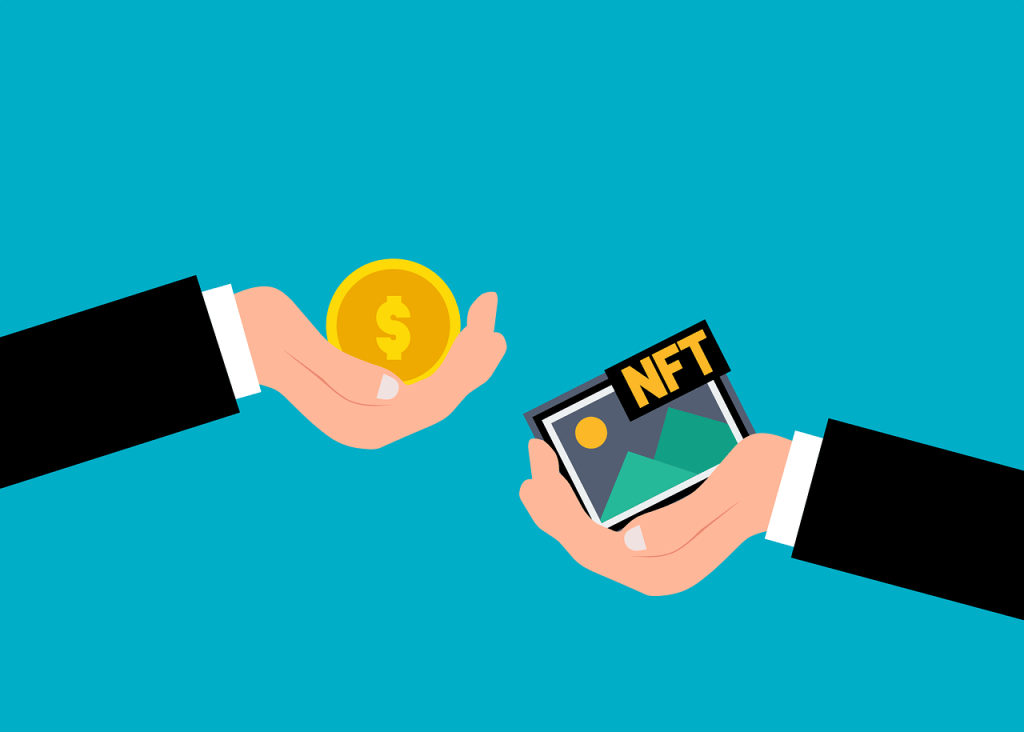
NFTs tend to be something that many people have heard of or talk about, but don’t really know what they exactly are. With the variety of NFTs around on the Internet and on the blockchain, it is no surprise that some have a hard time nailing down a solid definition.
What does “NFT” stand for?
The acronym NFT stands for Non-Fungible Token. According to the Merriam-Webster dictionary, if something is fungible, it can be replaced by another instance of said item because they have the same value (Merriam-Webster). For example, the US Dollar is fungible. A single USD$1 can be exchanged for another USD$1 and it will still be of the same value.
Thus, if something is non-fungible, it cannot be replaced with another instance of the same item since they do not have the same value. For example, one cannot exchange a pumpkin for a watermelon and expect the watermelon to hold the same value (in terms of money) as the pumpkin. This means that each NFT is unique and no two NFTs are alike. So, even if I made two NFTs of the exact same picture, they will not be equal in value as they are technically two “different” NFTs. (For example, if I took a picture of the Mona Lisa and printed it out exactly to scale, the printed photo would not be the same as the real Mona Lisa and I could not exchange my photo of the Mona Lisa for the original Mona Lisa).
What IS an NFT?
According to Investopedia, “NFTs (non-fungible tokens) are unique cryptographic tokens that exist on a blockchain and cannot be replicated” (Sharma). Imagine an NFT as being a deed or a receipt of ownership that is logged in a large book or ledger of verified receipts (the blockchain). NFTs prove that you have ownership of a given item, usually a digital one. This is why they are called “tokens”.
Even though they may seem complicated or fancy, NFTs are relatively easy to make (I have even made a few myself!). Many online NFT marketplaces, such as opensea.io, allow users to upload content and turn them into NFTs. However, in order to create and own NFTs, users must have some sort of cryptocurrency wallet or an account with a cryptocurrency exchange.
Oftentimes, NFTs are digital pictures. But, in theory, anything could be an NFT. Songs can be made into NFTs, physical documents (such as property deeds or diplomas) could be scanned and made into NFTs, and even items in video games or the Metaverse can be made into NFTs. NFTs are still a growing technology, so they may continue to evolve as time goes on.
Note: Please be cautious if you decide to give cryptocurrency or NFTs a try. While cryptocurrencies and NFTs are digital, you are using real money to purchase them. Exercise caution and do some research before signing up for any sort of cryptocurrency exchange/NFT marketplace account to avoid being scammed or losing your money. Further, it is important to understand that profits from cryptocurrency or NFTs are not free money. Taxes still apply to these profits. To get started, Coinbase is a reputable cryptocurrency exchange.
Works Cited & Further Reading
“Fungible.” Merriam-Webster.com Dictionary, Merriam-Webster, https://www.merriam-webster.com/dictionary/fungible. Accessed 11 Nov. 2022.
Sharma, Rakesh. “Non-Fungible Token (NFT): What It Means and How It Works.” Investopedia, Investopedia, 3 Nov. 2022, https://www.investopedia.com/non-fungible-tokens-nft-5115211.




Leave a Reply